Water Quality Index Development of
Jhajjar Distributary Region
Varsh Ranga • Krishna Tyagi • Lakshya Phalaswal
Aditya Ojha • Sushil
Professor & Head, Department of Environmental Engineering
Introduction: River Water and Groundwater
Surface Water vs. Groundwater Dynamics
- Fed by rainfall, runoff, canals and distributaries
- Exposed to sewage, industrial waste and agricultural runoff
- Quality changes with season and flow variations
- Jhajjar Distributary: ~25 km canal from Bhalaut to Dhaur
- Receives domestic & agricultural return flows
- High variability in TDS, EC and coliform counts
- Seasonal dilution during monsoon, concentration in summer
- Critical source for downstream irrigation & drinking supply
- Stored in alluvial aquifers of Indo-Gangetic plain
- Accessed via tube wells, hand pumps & bore wells
- Natural contaminants: Fluoride, Arsenic, Iron, Nitrate
- Human-induced pollution: Pesticides, fertilizers, leachate
- Slow recharge rate → pollutants persist for decades
- Jhajjar district: Groundwater is primary drinking source
- Declining water table due to over-extraction
A Water Quality Index (WQI) combines many parameters into a single score to judge water for drinking and irrigation.
PHYSICOCHEMICAL WATER QUALITY PARAMETERS (12 PARAMETERS)
Analyte Breakdown, Geochemical Origins & Environmental Significance
| Analyte / Parameter (Symbol) | Hydrochemical Significance & Toxicological Risks |
|---|---|
| pH (Acidity/Basicity) | Controls chemical speciation, heavy metal solubility, corrosivity, and palatability (Standard: 6.5–8.5). |
| TDS (Total Dissolved Solids) | Bulk indicator of mineral dissolution and salinity hazard; causes osmotic stress and gastrointestinal irritation. |
| Calcium (Ca²⁺) | Leached from calcite and dolomite; primary contributor to total hardness and household/boiler scaling. |
| Magnesium (Mg²⁺) | Hardness contributor from ferromagnesian minerals; exerts laxative purgative effects at elevated levels. |
| Sodium (Na⁺) | Silicate weathering and saline intrusions; critical driver of soil alkalization, dispersion, and sodicity hazard. |
| Potassium (K⁺) | Derived from orthoclase feldspar and NPK agricultural fertilizers; vital micronutrient with low baseline levels. |
| Total Alkalinity (TA) | Buffering capacity against acidification driven by HCO₃⁻/CO₃²⁻ from carbonate rock weathering. |
| Chloride (Cl⁻) | Conservative chemical tracer; elevated levels indicate municipal sewage, septic discharge, or saline backwater. |
| Sulphate (SO₄²⁻) | Gypsum dissolution and industrial runoff; causes bitter taste and cathartic laxative distress at >250 mg/L. |
| Nitrate (NO₃⁻) | Percolation of nitrogenous fertilizers and sewage; poses severe infant Methemoglobinemia ("Blue Baby Syndrome") risk. |
| Fluoride (F⁻) | Geogenic leaching from fluorite/apatite; levels > 1.5 mg/L cause irreversible dental and crippling skeletal fluorosis. |
| Total Hardness (TH) | Sum of divalent Ca²⁺ and Mg²⁺ ions; hinders soap lathering and shortens domestic/industrial piping lifespan. |
ANALYTICAL INSTRUMENTATION & TESTING PROTOCOLS
Standardized Experimental Assays, Instrumentation & Testing Procedures
| Parameter / Analyte | Analytical Method / Instrument | Experimental Protocol & Procedure Details |
|---|---|---|
| pH (Potential of Hydrogen) | Electrometric Method Digital pH Meter |
Measured electrometrically using a calibrated pH meter. Measures electrical potential due to H⁺ ions in solution. The measuring electrode system utilizes a standard glass electrode and calomel reference electrode calibrated with NIST standard buffer solutions (pH 4.01, 7.00, 9.20). |
| Total Alkalinity (TA) | Titrimetric Assay Acid Neutralization |
Standard wet-chemistry volumetric titration against 0.02 N H₂SO₄ using phenolphthalein and methyl orange indicators to determine total carbonate (CO₃²⁻), bicarbonate (HCO₃⁻), and hydroxide (OH⁻) buffering capacity. |
| Total Hardness (TH) | Complexometric Titration EDTA Method |
Complexometric titration using standard 0.01 M EDTA solution with Eriochrome Black T (EBT) indicator buffered at pH 10.0 (NH₄Cl-NH₄OH buffer) for total hardness (Ca²⁺ + Mg²⁺), with sharp wine-red to blue end-point. |
| Chloride (Cl⁻) | Argentometric Titration Mohr's Method |
Titrimetric assay using standardized 0.0141 N Silver Nitrate (AgNO₃) in presence of Potassium Chromate (K₂CrO₄) indicator until a distinct reddish-brown silver chromate (Ag₂CrO₄) precipitate forms. |
| Fluoride (F⁻) | Spectrophotometry SPADNS Colorimetry |
Colorimetric reaction using SPADNS reagent (Sodium 2-(parasulfophenylazo)-1,8-dihydroxy-3,6-naphthalenedisulfonate) and Zirconyl acid; bleaching of the red lake is measured spectrophotometrically at λ = 570 nm. |
| Calcium (Ca²⁺), Magnesium (Mg²⁺), Sodium (Na⁺), Potassium (K⁺) | AAS Atomic Absorption Spectrophotometry |
Measured by Atomic Absorption Spectrophotometry (AAS). Quantitative determination of major cations using element-specific hollow cathode lamps and air-acetylene flame atomization against matrix-matched multi-element standard calibration curves. |
| Sulphate (SO₄²⁻) | Turbidimetric Method UV-Vis Spectrophotometer |
Precipitation with Barium Chloride (BaCl₂) crystals in conditioning reagent medium to form uniform BaSO₄ colloidal suspension; turbidity absorbance is measured spectrophotometrically at λ = 420 nm. |
| Nitrate (NO₃⁻) | UV Spectrophotometry Dual-Wavelength Screening |
Direct UV spectrophotometric screening at λ = 220 nm with baseline organic matter absorption correction measured at λ = 275 nm using optical quartz cuvettes. |
| TDS (Total Dissolved Solids) | Gravimetric Method Whatman Filtration & Ignition |
Measured by filtration of water sample through Whatman filter paper (No. 42 / 0.45 µm) and subsequent drying/ignition of filtrate in a silica crucible heated at 550–650 °C to determine non-volatile dissolved mineral residue. |
REGULATORY STANDARDS & PARAMETER UNIT WEIGHT ASSIGNMENT
WHO & IS 10500 Regulatory Standards & Unit Weight Penalties
| Parameter (mg/L) | WHO Limit | IS 10500 | Unit Weight (Wn) | Rel. Weight |
|---|---|---|---|---|
| Fluoride (F⁻) | 1.5 | 1.0–1.5 | 0.620 | 62.0% (Highest) |
| pH (unitless) | 8.5 | 6.5–8.5 | 0.109 | 10.9% |
| Potassium (K⁺) | 12 | — | 0.078 | 7.8% |
| Total Hardness (TH) | 500 | 200–600 | 0.019 | 1.9% |
| Magnesium (Mg²⁺) | 50 | 30–100 | 0.019 | 1.9% |
| Nitrate (NO₃⁻) | 50 | 45 | 0.019 | 1.9% |
| Calcium (Ca²⁺) | 200 | 75–200 | 0.005 | 0.5% |
| Sodium (Na⁺) | 200 | — | 0.005 | 0.5% |
| Sulphate (SO₄²⁻) | 250 | 200–400 | 0.004 | 0.4% |
| Chloride (Cl⁻) | 250 | 250–1000 | 0.004 | 0.4% |
| Total Alkalinity (TA) | 500 | 200–600 | 0.002 | 0.2% |
| TDS | 1000 | 500–2000 | 0.001 | 0.1% |
Fluoride (Wn = 0.620) and pH (Wn = 0.109) together command almost three-quarters of the entire WQI penalty function.
TOXICITY THRESHOLDBecause Wn is inversely proportional to permissible standard Sn, any marginal exceedance of Fluoride above 1.5 mg/L triggers severe index inflation, categorizing water as "Very Poor" or "Unfit" for human consumption.
FIELD STUDY AREA: JHAJJAR DISTRIBUTARY SYSTEM
Western Yamuna Canal Command | Hydrological Corridor & Agricultural Lifeline
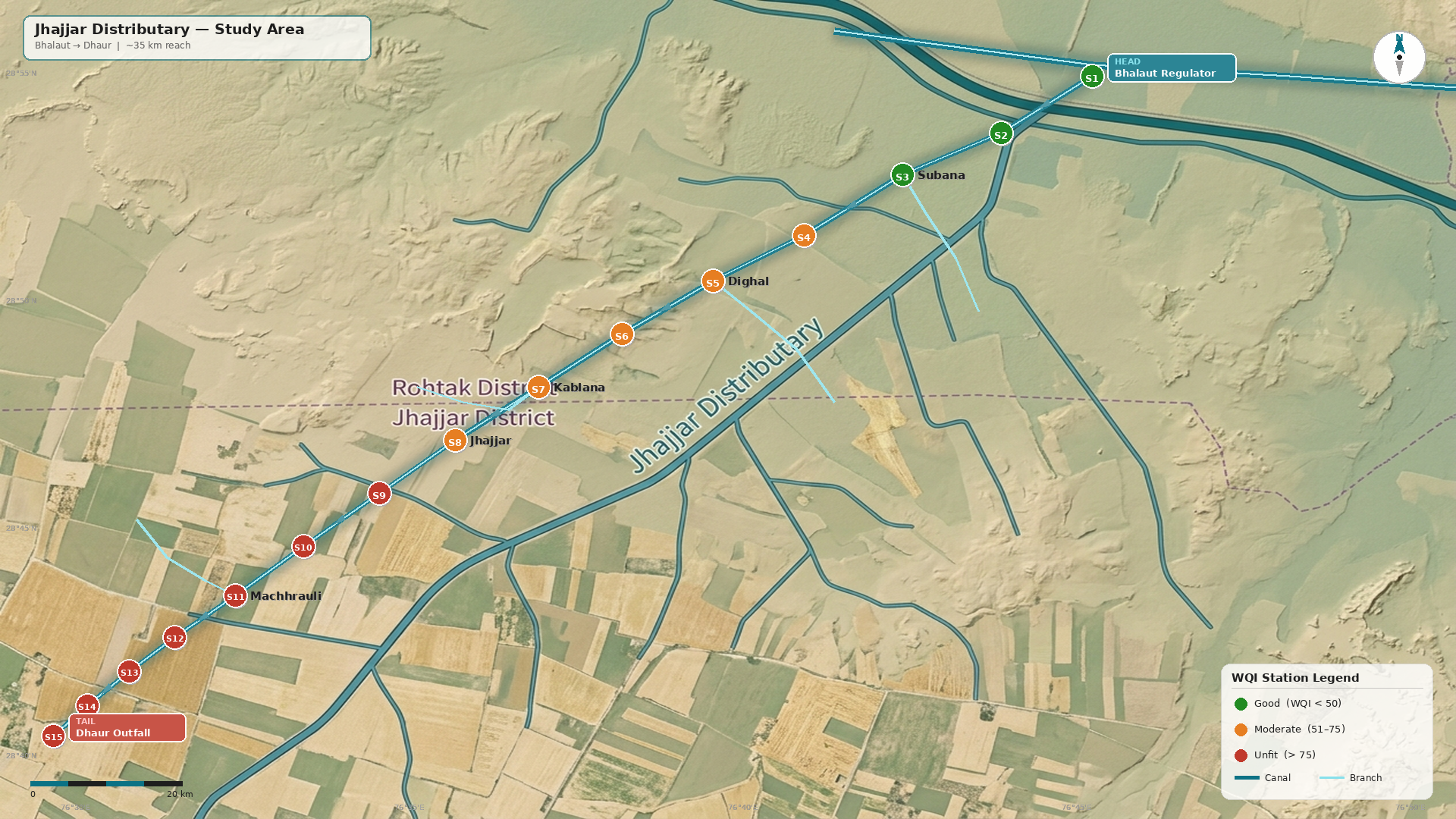
- Canal Alignment & Reach: Originates from Bhalaut Regulator on the Western Yamuna Canal (WYC) system; courses ~25–35 km southwards through Jhajjar district, terminating near Dhaur outfall.
- Command Area Served: Culturable Command Area (CCA) of ~18,500 hectares (ha) of fertile agricultural land across multiple agrarian villages in Jhajjar district.
- Agricultural Lifeline: Provides essential gravity-fed irrigation for ~18,500 ha producing Wheat, Mustard, Pearl Millet (Bajra), and Paddy.
- Aquifer Recharge Corridor: Acts as the primary freshwater artificial infiltration buffer that continuously replenishes shallow aquifers against regional brackish/saline groundwater intrusion.
- Environmental Vulnerabilities: Marked tail-end conveyance losses, agricultural runoff (pesticides, nitrates), livestock washing, bank erosion, and localized untreated graywater dumping.
MATHEMATICAL FORMULATION: DRINKING (WQI) & IRRIGATION (IWQI)
Weighted Arithmetic Formulation & Agronomic Soil-Water Alkalinity Indices
WQI combines many parameters into a single score that tells how suitable water is for drinking by using the weighted arithmetic index method.
Wn = K / Sn | K = 1 / Σ(1/Sn)
• Wn = Unit weight of n-th parameter
• Sn = Standard permissible limit
• K = Proportionality constant
Qn = 100 × [(Vn - Vi) / (Sn - Vi)]
• Vn = Measured experimental value
• Vi = Ideal pure water value (Vi = 0 for chemical ions; Vi = 7.0 for neutral pH)
• Sn = Standard permissible limit
WQI = Σ(Qn × Wn) / ΣWn
• Composite weighted quality score (where ΣWn = 1.0)
Irrigation suitability depends on salinity and sodium hazard, which affect soil structure, permeability and crop growth. It is assessed with four indices, classified separately, using ions in meq/L.
SAR = Na⁺ / √[(Ca²⁺ + Mg²⁺) / 2]
Measures sodium alkali hazard & soil dispersion
%Na = [(Na⁺ + K⁺) / (Ca²⁺ + Mg²⁺ + Na⁺ + K⁺)] × 100
Evaluates sodium concentration vs total cations
MH = [Mg²⁺ / (Ca²⁺ + Mg²⁺)] × 100
KR = Na⁺ / (Ca²⁺ + Mg²⁺)
MH assesses magnesium toxicity; KR assesses excess sodium
WATER CLASSIFICATION MATRIX & SUITABILITY SCALES
Potability Tiers (Drinking WQI) vs. Agronomic Thresholds (Irrigation IWQI)
| WQI Range | Classification | Suitability Action |
|---|---|---|
| 0 – 25 | Excellent | Pristine; direct potable consumption. |
| 26 – 50 | Good | Standard domestic use; basic filtration. |
| 51 – 75 | Moderately Poor | Treatment required; coagulation/filtration. |
| 76 – 100 | Very Poor | Unsuitable for direct use; advanced RO needed. |
| > 100 | Unfit | Severe health hazard; prohibited from drinking. |
| Irrigation Index | Range | Agronomic Class |
|---|---|---|
| Sodium % (%Na) | < 60% > 60% |
Suitable Unfit (Deflocculation) |
| SAR (Richards) | < 10 10–18 18–26 > 26 |
Excellent Good Doubtful Unfit |
| MH (Szabolcs) | < 50 > 50 |
Safe Unfit (Soil Alkalinity) |
| Kelley's Ratio | < 1.0 > 1.0 |
Suitable Unfit (Na Hazard) |
Our Progress
Current Milestone Status & Next Experimental Phases
- Studied the water quality parameters and how each one is tested
- Examined various areas and selected the Jhajjar Distributary
- Finding sampling locations and collecting samples for testing
- Test the samples in the laboratory
- Calculate WQI and IWQI and assess the water quality of the distributary
THANK YOU & KEY REFERENCES
Academic Citations, Methodological Benchmarks & Q&A Discussion
We sincerely appreciate your valuable time, feedback, and guidance.
Domain: Environmental Engineering & Water Resources
Faculty Guide: Prof. Athar Hussain
Evaluation: Midterm Milestone Review & Roadmap
- Distributary reach station selection & sampling spatial distribution
- QA/QC verification with Charge Balance Error (CBE < 5%)
- Comparative sensitivity of Drinking WQI vs. Irrigation IWQI
Scientific Reports, 15:37675. DOI:
10.1038/s41598-025-21592-4
- IS 10500:2012 — Bureau of Indian Standards: Indian Standard Drinking Water — Specification (Second Revision), New Delhi.
- WHO (2017) — World Health Organization: Guidelines for Drinking-water Quality (4th Edition), Geneva.
- APHA (2017) — Standard Methods for the Examination of Water and Wastewater (23rd Edition), American Public Health Association, Washington, D.C.