Water Quality Index Development of
Jhajjar Distributary Region
Varsh Ranga • Krishna Tyagi • Lakshya Phalaswal
Aditya Ojha • Sushil
Professor & Head, Department of Environmental Engineering
Senior Author, Nature Scientific Reports (2025)
Introduction: River Water and Groundwater
Surface Water vs. Groundwater Dynamics
- Fed by rainfall, runoff, canals and distributaries
- Exposed to sewage, industrial waste and agricultural runoff
- Quality changes with season and flow
- Stored in aquifers; used through tube wells and hand pumps
- Contaminated by natural sources (e.g. fluoride) and human activity
- Recharges slowly, so pollution stays for a long time
A Water Quality Index (WQI) combines many parameters into a single score to judge water for drinking and irrigation.
PHYSICOCHEMICAL WATER QUALITY SUITE (12 PARAMETERS)
Geochemical Grouping, Health Hazards & Environmental Significance
| Parameter Suite | Analyte (Symbol) | Hydrochemical Significance & Toxicological Risks |
|---|---|---|
| Physical / Aggregate | pH (Acidity/Basicity) | Controls chemical speciation, heavy metal solubility, corrosivity, and palatability (Standard: 6.5–8.5). |
| Physical / Aggregate | TDS (Total Dissolved Solids) | Bulk indicator of mineral dissolution and salinity hazard; causes osmotic stress and gastrointestinal irritation. |
| Major Cation | Calcium (Ca²⁺) | Leached from calcite and dolomite; primary contributor to total hardness and household/boiler scaling. |
| Major Cation | Magnesium (Mg²⁺) | Hardness contributor from ferromagnesian minerals; exerts laxative purgative effects at elevated levels. |
| Major Cation | Sodium (Na⁺) | Silicate weathering and saline intrusions; critical driver of soil alkalization, dispersion, and sodicity hazard. |
| Major Cation | Potassium (K⁺) | Derived from orthoclase feldspar and NPK agricultural fertilizers; vital micronutrient with low baseline levels. |
| Major Anion | Total Alkalinity (TA) | Buffering capacity against acidification driven by HCO₃⁻/CO₃²⁻ from carbonate rock weathering. |
| Major Anion | Chloride (Cl⁻) | Conservative chemical tracer; elevated levels indicate municipal sewage, septic discharge, or saline backwater. |
| Major Anion | Sulphate (SO₄²⁻) | Gypsum dissolution and industrial runoff; causes bitter taste and cathartic laxative distress at >250 mg/L. |
| Critical Toxicant | Nitrate (NO₃⁻) | Percolation of nitrogenous fertilizers and sewage; poses severe infant Methemoglobinemia ("Blue Baby Syndrome") risk. |
| Critical Toxicant | Fluoride (F⁻) | Geogenic leaching from fluorite/apatite; levels > 1.5 mg/L cause irreversible dental and crippling skeletal fluorosis. |
| Aggregate Hardness | Total Hardness (TH) | Sum of divalent Ca²⁺ and Mg²⁺ ions; hinders soap lathering and shortens domestic/industrial piping lifespan. |
ANALYTICAL INSTRUMENTATION & TESTING PROTOCOLS
Standardized Experimental Assays & Wet-Chemistry Laboratory Instrumentation
- Total Alkalinity: Standard 0.02 N H₂SO₄ neutralization with phenolphthalein & methyl orange indicators.
- Hardness (Ca²⁺ & Mg²⁺): Complexometric EDTA titration using Eriochrome Black T (EBT) & Murexide indicators.
- Chloride (Cl⁻): Mohr's argentometric titration using standardized AgNO₃ with K₂CrO₄ indicator.
- Dual Sensors: Combined glass-bulb pH electrode and conductometric cell for immediate on-site reads.
- Calibration Standard: 3-point NIST buffer calibration (pH 4.01, 7.00, 9.20) and 1413 µS/cm KCl solution.
- In-Situ Acquisition: Real-time determination of pH, EC (µS/cm), and TDS with automatic temperature compensation (ATC).
- Instrumentation: Digital Flame Photometer configured for Na (589 nm) and K (766 nm) atomic emission.
- Calibration Matrix: 5-point standard stock calibration series (0–100 mg/L) prepared from analytical-grade salts.
- High Specificity: Flame atomization eliminates spectral interferences common in multi-ion groundwater.
- Fluoride (F⁻): SPADNS colorimetric assay at λ = 570 nm (bleaching of red acid-zirconyl complex).
- Nitrate (NO₃⁻): Direct UV spectrophotometric screening at λ = 220 nm with correction at λ = 275 nm.
- Sulphate (SO₄²⁻): Barium sulphate (BaSO₄) turbidimetric suspension assay measured at λ = 420 nm.
STANDARDIZED 4-STAGE LAB WORKFLOW & RIGOROUS QA/QC PROTOCOLS
Experimental Framework & Normalized Charge Balance Error Standards (Prof. Athar Hussain et al., 2025)
- APHA 1060: Standardized sampling container preparation.
- Bottle Cleaning: Pre-washed with 10% HNO₃ & double-rinsed in deionized water.
- Well Purging: 10-minute evacuation of stagnant casing water prior to collection.
- Headspace: Sealed with zero headspace; stored at 4°C in dark coolers.
- Real-Time Logging: Immediate recording of Temperature, pH, EC, and TDS.
- Equilibrium Lock: Prevents CO₂ degassing and CaCO₃ precipitation during transport.
- Calibration: NIST buffers (pH 4.01, 7.00, 9.20) with Automatic Temp Compensation.
- APHA 2320 B: Alkalinity via standard acid titration.
- APHA 2340 C: Hardness via EDTA titration.
- APHA 4500-F⁻ D: Fluoride via SPADNS (570 nm).
- APHA 4500-NO₃⁻ B: Nitrate via UV Spectrometry.
- APHA 4500-Cl⁻ B: Chloride via Mohr's titration.
- Ionic Balance: Normalized Charge Balance Error verification.
- Calibration R²: Multi-point standard curves with R² > 0.999.
- Controls: Matrix spikes, reagent blanks, and triplicate sample assays.
REGULATORY STANDARDS & PARAMETER UNIT WEIGHT ASSIGNMENT
WHO & IS 10500 Limits with Weighted Unit Penalties (Wn = K / Sn)
| Parameter (mg/L) | WHO Limit | IS 10500 | Unit Weight (Wn) | Rel. Weight |
|---|---|---|---|---|
| Fluoride (F⁻) | 1.5 | 1.0–1.5 | 0.620 | 62.0% (Highest) |
| pH (unitless) | 8.5 | 6.5–8.5 | 0.109 | 10.9% |
| Potassium (K⁺) | 12 | — | 0.078 | 7.8% |
| Total Hardness (TH) | 500 | 200–600 | 0.019 | 1.9% |
| Magnesium (Mg²⁺) | 50 | 30–100 | 0.019 | 1.9% |
| Nitrate (NO₃⁻) | 50 | 45 | 0.019 | 1.9% |
| Calcium (Ca²⁺) | 200 | 75–200 | 0.005 | 0.5% |
| Sodium (Na⁺) | 200 | — | 0.005 | 0.5% |
| Sulphate (SO₄²⁻) | 250 | 200–400 | 0.004 | 0.4% |
| Chloride (Cl⁻) | 250 | 250–1000 | 0.004 | 0.4% |
| Total Alkalinity (TA) | 500 | 200–600 | 0.002 | 0.2% |
| TDS | 1000 | 500–2000 | 0.001 | 0.1% |
Fluoride (Wn = 0.620) and pH (Wn = 0.109) together command almost three-quarters of the entire WQI penalty function.
TOXICITY THRESHOLDBecause Wn is inversely proportional to permissible standard Sn, any marginal exceedance of Fluoride above 1.5 mg/L triggers severe index inflation, categorizing water as "Very Poor" or "Unfit" for human consumption.
FIELD STUDY AREA: JHAJJAR DISTRIBUTARY SYSTEM
Western Yamuna Canal Command | Hydrological Corridor & Agricultural Lifeline
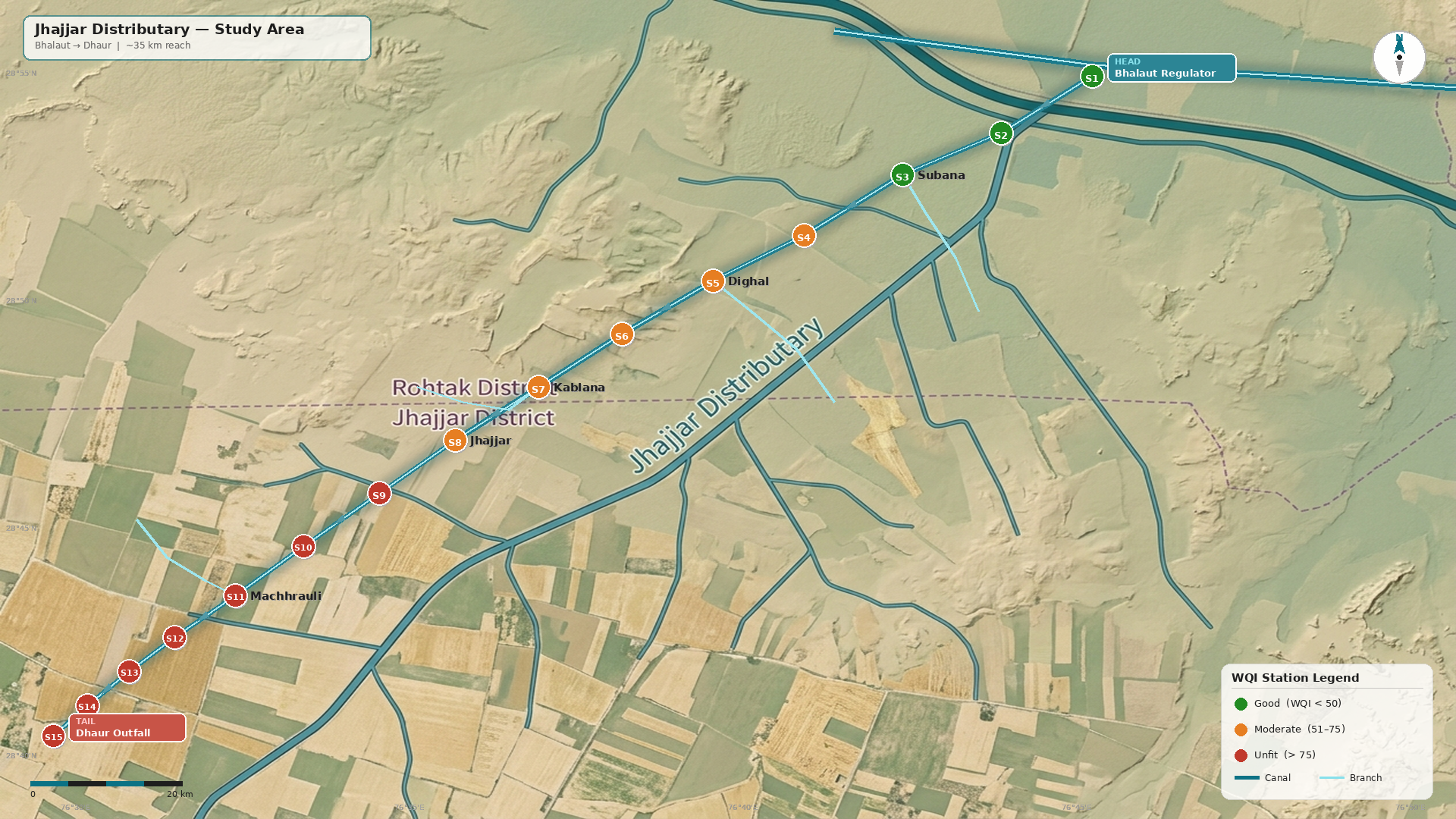
- Canal Alignment & Reach: Originates from Bhalaut Regulator on the Western Yamuna Canal (WYC) system; courses ~32–35 km southwards through Jhajjar district, terminating near Dhaur outfall.
- Agricultural Lifeline: Provides gravity-fed irrigation for extensive agrarian tracts producing Wheat, Mustard, Pearl Millet (Bajra), and Paddy.
- Aquifer Recharge Corridor: Acts as the primary freshwater artificial infiltration buffer that continuously replenishes shallow aquifers against regional brackish/saline groundwater intrusion.
- Environmental Vulnerabilities: Marked tail-end conveyance losses, agricultural runoff (pesticides, nitrates), livestock washing, bank erosion, and localized untreated graywater dumping.
MATHEMATICAL FORMULATION: DRINKING (WQI) & IRRIGATION (IWQI)
Weighted Arithmetic Formulation & Agronomic Soil-Water Alkalinity Indices
Wn = K / Sn | K = 1 / Σ(1/Sn)
Qn = 100 × [(Vn - Vi) / (Sn - Vi)]
Vi = 0 for chemical ions; Vi = 7.0 for neutral pH
WQI = Σ(Qn × Wn) / ΣWn
SAR = Na⁺ / √[(Ca²⁺ + Mg²⁺) / 2]
%Na = [(Na⁺ + K⁺) / (Ca²⁺ + Mg²⁺ + Na⁺ + K⁺)] × 100
MH = [Mg²⁺ / (Ca²⁺ + Mg²⁺)] × 100
KR = Na⁺ / (Ca²⁺ + Mg²⁺)
WATER CLASSIFICATION MATRIX & SUITABILITY SCALES
Potability Tiers (Drinking WQI) vs. Agronomic Thresholds (Irrigation IWQI)
| WQI Range | Classification | Suitability Action |
|---|---|---|
| 0 – 25 | Excellent | Pristine; direct potable consumption. |
| 26 – 50 | Good | Standard domestic use; basic filtration. |
| 51 – 75 | Moderately Poor | Treatment required; coagulation/filtration. |
| 76 – 100 | Very Poor | Unsuitable for direct use; advanced RO needed. |
| > 100 | Unfit | Severe health hazard; prohibited from drinking. |
| Irrigation Index | Range | Agronomic Class |
|---|---|---|
| Sodium % (%Na) | < 60% > 60% |
Suitable Unfit (Deflocculation) |
| SAR (Richards) | < 10 10–18 18–26 > 26 |
Excellent Good Doubtful Unfit |
| MH (Szabolcs) | < 50 > 50 |
Safe Unfit (Soil Alkalinity) |
| Kelley's Ratio | < 1.0 > 1.0 |
Suitable Unfit (Na Hazard) |
PROJECT MILESTONES, CURRENT PROGRESS & RESEARCH ROADMAP
Chronological Execution Path & Advanced Modeling Pipeline (Hussain et al., 2025)
- Parameter Suite: Comprehensive review of 12 physicochemical parameters & toxicological benchmarks (WHO & IS 10500:2012).
- Reconnaissance Survey: On-site reconnaissance along the Jhajjar Distributary (~32–35 km reach from Bhalaut to Dhaur).
- Computational Framework: Structured mathematical pipelines for WQI, IWQI, and CBE ionic balance verification.
- GPS Geo-Referencing: Identifying 15–20 strategic GPS sampling stations across head, mid-reach, and tail-end canal sectors.
- Pre-Monsoon Sampling: Procuring water samples in acid-washed HDPP bottles adhering to APHA 1060 guidelines.
- In-Situ Probing: Real-time field logging of Temperature, pH, EC, and TDS with calibrated multi-probe sensor kits.
- Laboratory Assays: Titrimetric and UV-Vis spectrophotometric (Shimadzu UV-1800) testing with strict QA/QC (CBE ≤ ±5%).
- Hydrochemical Facies: Piper trilinear diagrams and spatial GIS interpolations to classify dominant geochemical facies.
- Machine Learning: Implementing XGBoost, Random Forest, and ANN models for WQI prediction following Hussain et al. (2025).